













Dujiangyan Scenic Area ticketing could hardly be simpler: one e-ticket, one QR code, and you are walking the levees of a water system that has run without interruption since around 256 BC. The online partner fare currently starts at US$11.99 on Trip.com — and it saves you from the ticket-counter queue that reviewers consistently warn about. We walk the weir works several times a year in every season, and this guide covers everything an international traveler needs for 2026: what the price actually includes, which ticket type fits your plan, how entry works, and the seasonal clock that decides when you must leave the park.
Key takeaways
- From US$11.99 booked online through Trip.com — and the queue at the ticket windows is exactly what you are skipping.
- Two seasonal clocks: Mar 2–Oct 31 the park runs 08:00–18:00 (tickets until 17:30); Nov 1–Mar 1 it runs 08:00–17:30 (tickets until 17:00).
- Enter by QR code — no printing, no ticket window; scan at the turnstile and follow the river path.
- One rule travelers miss: everyone must leave the park — by 20:00 in summer season and 19:30 in winter season, no late staying.
- Rated 4.7/5 by 57,958 travelers on Trip.com and named among the 2026 Asia 100 – Best Things to Do.
Quick answer: for most international travelers the fastest route is booking through Trip.com — English interface, any foreign card, instant confirmation. Getting tickets through local mini-programs is genuinely difficult without a Chinese account, which is exactly why reviewers tell non-Chinese visitors to book online instead.
What the ticket includes
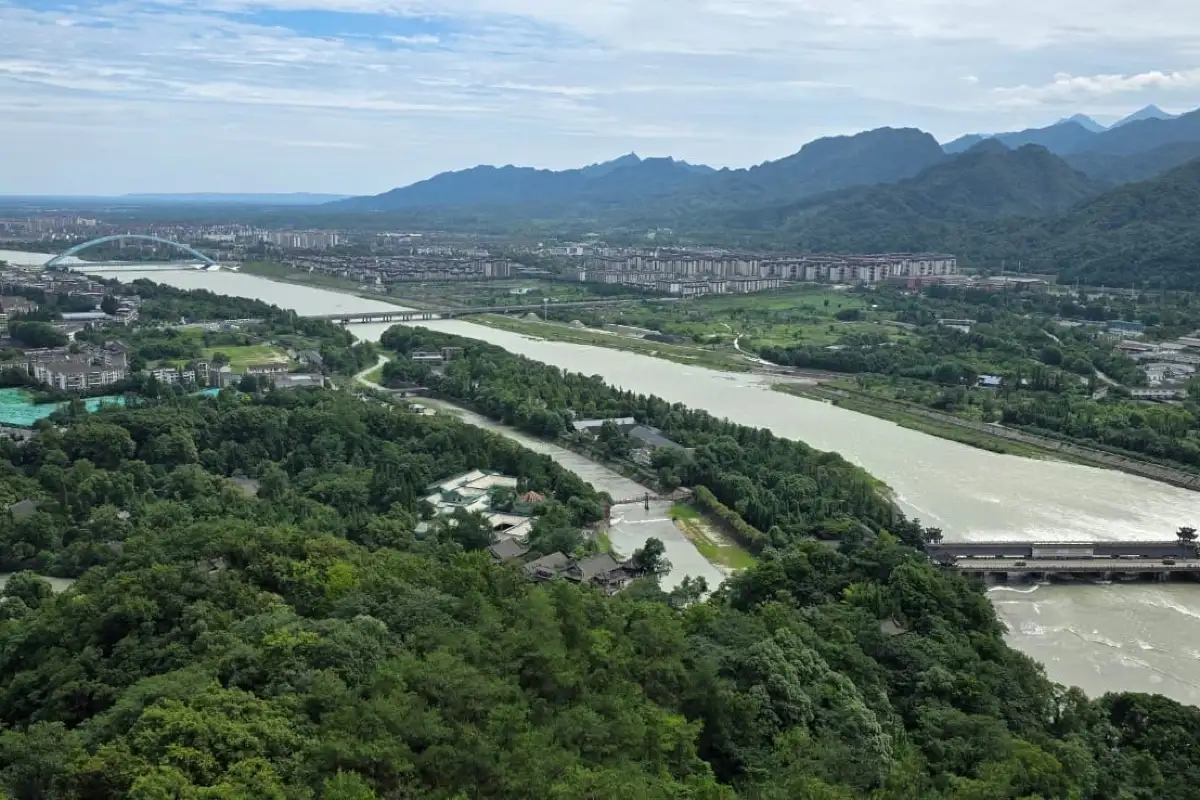
The core admission covers the whole hydraulic story in one walkable loop: Lidui Park with the Bottle-Neck cliff of Baopingkou, the riverside paths out to Fish Mouth, the Anlan Suspension Bridge across the inner river, the Feishayan Spillway, the temple courtyards of Erwang Miao on the slope, and the exhibition halls that explain how Li Bing’s engineers tamed the Min River around 256 BC — without a single dam. Interpretive signs along the route are bilingual, and in-park shuttle carts, restrooms, rest points, a souvenir shop and convenience stores are all part of the scenic area’s standard amenities.
Step out of the main gate and the visit continues for free: Guanxian Ancient Town — the old county town that grew rich on the water works — lines the river with teahouses, snack streets and the canal-side promenade. Most visitors finish the loop through the old town, which turns the ticket into a full half-day of history, engineering and food.
Worth knowing: ticketing is real-name. Bring your passport, and make sure the name on the booking matches your ID. Children, students and seniors enjoy discounted entries — but pets are not allowed anywhere in the scenic area, and drone flights are prohibited across the park.
How much tickets cost (2026)
For international travelers there is essentially one play: the online e-ticket, which starts at US$11.99 per adult on Trip.com and varies by ticket type and travel date. Combined tickets that add Mount Qingcheng — the Taoist mountain of the same UNESCO World Heritage inscription — are sold alongside the standard entry, and discounted fares exist for seniors, students and children. On-the-day prices at the window are rarely cheaper, and they come with a queue.
| Option | Best for | What to know |
|---|---|---|
| Standard entry e-ticket | First-timers; the full loop | From US$11.99 (instant confirmation, QR-code entry) |
| Dujiangyan + Mount Qingcheng combo | The full World Heritage day | Both halves of the 2000 UNESCO inscription; check same-day and next-day validity before paying |
| Discounted entries | Seniors, students, children | Bring ID or passport; eligibility checked at the gate |
| Peak-season visit | Water Releasing Festival, holidays | Book ahead — entry windows and park-exit times still apply |
| Window ticket | Impulse visits only | Behind a long queue on peak days; reviewers advise against it |
| Local mini-program | Chinese phone users | Fiddly without a Chinese account or payment setup — skip it |
Why is the online fare the smart buy? Trip.com runs a standing partner promotion on the official listing, and the e-ticket puts you in the fast lane: scan the QR code at the turnstile instead of lining up at the counter with everyone else. For the price of a coffee, you buy yourself an earlier start — and at a site where the light is best before 10:00, an earlier start is the real upgrade.
The two seasonal clocks
Dujiangyan runs on a strict seasonal schedule, and it is the detail travelers most often get wrong:
- Summer season (Mar 2 – Oct 31): park open 08:00–18:00, tickets sold until 17:30, and everyone must leave by 20:00 on the day of visit.
- Winter season (Nov 1 – Mar 1): park open 08:00–17:30, tickets sold until 17:00, and everyone must leave by 19:30.
- Holidays vary — opening hours may adjust around Chinese public holidays, so confirm with the hotlines (+86-28-96526 / +86-28-87298269) if your visit is short.
Step-by-step: booking your ticket
The whole flow takes about five minutes on any international phone:
- Step 1. Open the Dujiangyan Scenic Area ticket page and select your date and ticket type — standard entry or a Mount Qingcheng combo.
- Step 2. Enter traveler details exactly as they appear in your passport (real-name ticketing).
- Step 3. Pay with any international card. The QR-code e-ticket lands in your e-mail within minutes.
- Step 4. Screenshot the voucher as backup for weak signal at the gate, and remember your passport on the day.
- Step 5. At the Park Road entrance, scan the code at the turnstile and follow the river path into Lidui Park — the loop does the rest.
From real trips: the visitors who had the best experiences were the organized ones — booked online in advance, QR code ready, passport in pocket, and (the pro move) through the gate by 08:00. The park rewards the small preparations: real shoes for the 4–6 km loop, a zoom lens instead of a forbidden drone, and a plan that ends in the ancient town.
Timing your visit right
The gates open at 08:00 in both seasons, and the first two hours are the best of the day: cool air, soft light, quiet paths and an Anlan Bridge with room to breathe. Tour groups from Chengdu arrive from mid-morning; by 15:00 the loop is at its fullest, and in winter the light starts fading well before the 17:30 close.
- Weekday beats weekend — Chinese weekends and public holidays fill the paths; a weekday at opening is the calmest window of all.
- April is special but busy — the Water Releasing Festival in early April re-enacts the ancient channel opening with ceremonies; go for the spectacle, arrive extra early for the space.
- Watch both clocks — ticket windows close at 17:30 (summer) or 17:00 (winter), and the park-exit times are enforced. Enter earlier than you think.
Frequently asked questions
Do I need to print my ticket?
No. The ticket is fully digital — show the QR-code e-ticket on your phone at the turnstile, with your ID or passport. Keep a screenshot as a backup in case of weak signal at the gate.
Is one ticket enough for Mount Qingcheng too?
Only if you buy a combo ticket — the standard entry covers Dujiangyan Scenic Area alone. Trip.com lists combined options that add Mount Qingcheng, the twin site of the 2000 UNESCO inscription; check the validity window (same-day or next-day) on the checkout page before you pay.
How much time should I allow?
The recommended sightseeing time is 3–5 hours. The core loop — Lidui Park, Baopingkou, the Anlan Bridge, Yuzui and Erwang Temple — takes 3–4 hours at an easy pace; the ancient town at the gate easily adds another hour with street food and teahouses.
What is included vs. extra?
All the weir works, the bridge, the temples and the exhibition halls are included with admission. In-park shuttle transport, food, drinks and souvenirs are extra. There are no “VIP” tickets — the real upgrade is entering at 08:00 before everyone else.
How long before my visit should I book?
Same-day booking usually works on weekdays, but on weekends and Chinese public holidays book ahead — the e-ticket saves the most time exactly when the park is fullest. Book the night before and you simply scan and walk in.
Book your ticket, then plan the day
2,280 years of engineering — book the early entry first
Instant confirmation, any international card, QR-code entry. Just bring your phone — and your passport — on the day.
With the ticket sorted, line up the rest of the day: pick your season with the best-time guide, choose a plan in the itineraries guide, and skim the must-see highlights before you go. The essentials — transport, the walking route, rules — live in the Visitor Guide, and real traveler experiences are in the reviews section on our front page.
Sources & official references
- Trip.com — Dujiangyan Scenic Area attraction listing (checked October 2026): ticket prices from $11.99, summer hours 08:00–18:00 / winter 08:00–17:30, tickets until 17:30/17:00, park exit by 20:00/19:30.
- Ticket-inquiry hotlines +86-28-96526 and +86-28-87298269 for tickets, schedules and group bookings.
- Verified traveler reviews on Trip.com (57,958 reviews, 4.7/5 average) for entry flow, timing and ticket-type advice.
- UNESCO World Heritage inscription No. 1001 (Mount Qingcheng and the Dujiangyan Irrigation System, 2000): construction around 256 BC, dam-free design, ~668,700 hectares irrigated.
- Official scenic-area information: no pets allowed, drone flights prohibited; amenities include parking, in-park transport, restrooms, souvenir shop, convenience store and phones.
- On-site signage and exhibits, verified by our editorial team on 2025–2026 visits.
