













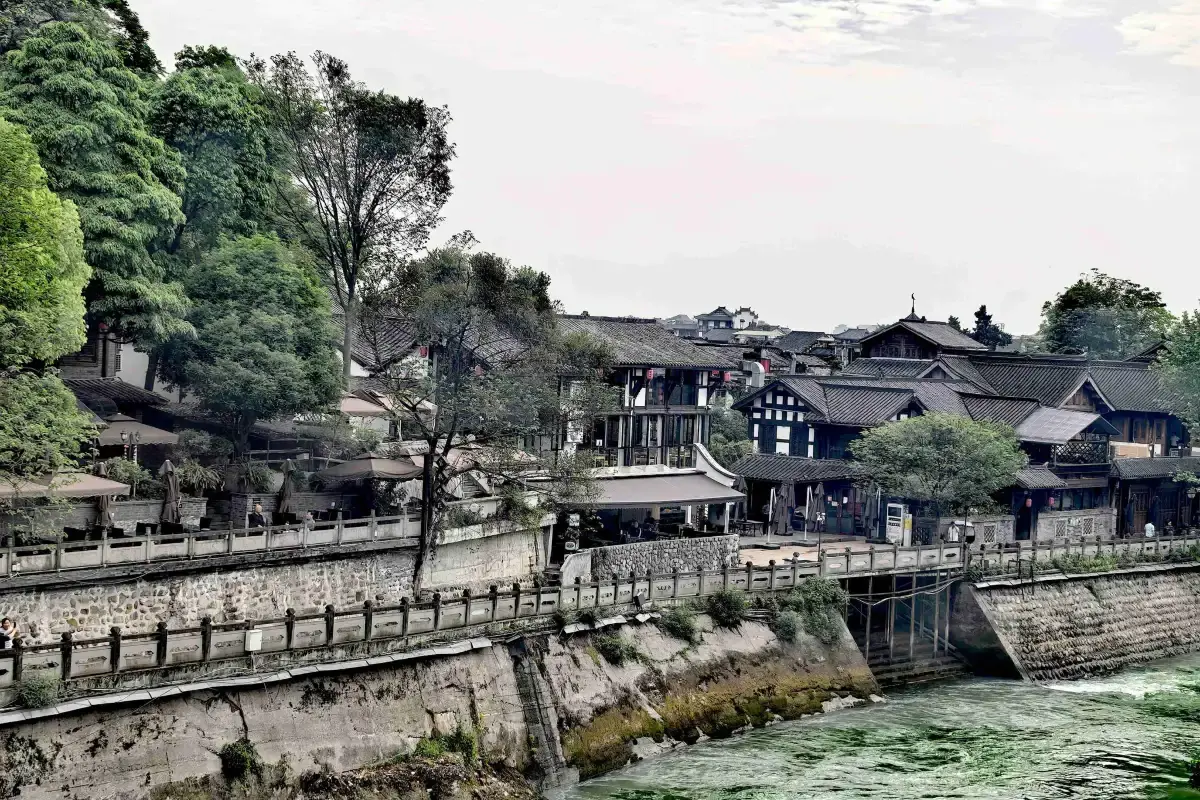
Dujiangyan is a photographer’s argument for walking: no drones allowed, no night shoot inside the gates, and still one of the most rewarding half-days of frames in Sichuan. The subjects do the work — turquoise water splitting around a 2,280-year-old dike, a swaying rope bridge, temple roofs stacked above the current, and a lantern-lit ancient town for the evening. This guide maps the shots, the light and the one rule that shapes all of it (the tripod-free, drone-free reality of a protected heritage park).
Key takeaways
- No drones, ever — flights are prohibited across the park and enforced; the best angles are on foot, so bring a zoom instead.
- Golden windows: 08:00–10:00 for empty frames and soft light on the water; golden hour along the inner river before the 17:30/17:00 ticket deadline.
- The money shot: mid-span on the Anlan Bridge — planks, cables, the dividing dike and the two channels in one compression.
- Summer bonus: flood season turns the Feishayan Spillway white — the most dramatic water frames of the year.
- Evening shift: the park empties by 20:00/19:30 — shoot Nanqiao and the ancient town lanterns outside the gate after.
Before you shoot: entry is by the Trip.com e-ticket — photographers book ahead to enter at 08:00 with the first light and no crowds in the frame.
Six frames worth the walk
- 1. Mid-span, Anlan Bridge. The signature image: cable lines and planks leading down to the divided river. Shoot early — the planks empty at 08:00 and fill by 10:00.
- 2. Yuzui from the lookout. Walk down to the fish-mouth platform for a low angle of water wrapping both sides of the dike; a polarizer tames the surface glare.
- 3. The Bottle-Neck cliff. From Lidui Park, frame the vase-shaped Baopingkou cut with green water sliding through — the purest “how, in 256 BC?” photograph in the park.
- 4. Feishayan in flood. Summer only: white water spinning off the spillway. Shutter around 1/500s freezes the spray; 1/8s turns it silk (tripods are awkward on the paths — brace on rails).
- 5. Erwang Temple terraces. The overview: grey tile ridges, upturned eaves, cypress silhouettes, the works and the river below — the frame that explains the whole system.
- 6. Nanqiao at blue hour. Outside the gate, the corridor bridge lights up at dusk; shoot from the riverside walkway as the ancient town’s lanterns come on.
Light through the day and the year
The valley runs north-west, so morning light slides softly down the mountains onto the water while the inner river stays in gentle shade — ideal for the bridge and dike frames. Midday is harsh except in winter, when the low sun keeps the whole loop photographer-friendly all day. Summer brings drama: dark clouds and white spillway spray between showers (carry a cloth, wipe the lens often). Autumn adds red-and-gold hillsides behind green water; winter trades color for mist — the classical-painting mornings that make the temple roofs float. One late-November visitor described it simply: beautiful atmosphere, absolutely worth it.
Gear for a drone-free park
- 24–200mm in one body — the loop rewards switching between wide bridge frames and long-lens temple compressions without a bag swap on a narrow path.
- A polarizer — the river is the subject; cutting glare doubles the color in every frame from the bridge.
- Spare battery + power bank — 4–6 km of walking and cold winter wind drain phones and cameras alike; convenience stores sell snacks, not camera batteries.
- Comfortable shoes, small bag — no tripod needed (brace on rails and railings), and security prefers compact bags at the gate.
- Leave the drone at the hotel — seriously: flights are prohibited park-wide. The rangers do enforce it, and the walkable angles are better anyway.
The evening shift: ancient town
The water works close with the light — park exit by 20:00 in summer season, 19:30 in winter — but the photography doesn’t. Guanxian Ancient Town and the Nanqiao corridor at the park entrance carry the evening: lantern-lit canals, steaming food streets, teahouse windows and the illuminated bridge reflected in the inner river. Blue hour comes fast in the valley; arrive at the riverside walkway twenty minutes before sunset, and let the ancient town finish the set. (Photography rule of thumb for the whole day: the 3–5 hour loop leaves you out of the gate exactly on time for blue hour.)
Frequently asked questions
Can I fly a drone over the weir works?
No — drone flights are prohibited across Dujiangyan Scenic Area, and the rule is enforced on the ground. Shoot from the walkable viewpoints; between the bridge, the lookout and the temple terraces, the aerial-style frames already exist at eye level.
When is the water most photogenic?
Summer flood season for drama (white water over the Feishayan Spillway), and clear autumn or winter mornings for the turquoise calm. April’s festival adds people and ceremony to the frames if you want a human element.
How do I avoid crowds in my shots?
Enter at 08:00 and shoot the bridge first; walk the loop in reverse (temple → dike → bridge) to meet tour groups head-on instead of following them; and use the long lens to compress above the heads on narrow paths.
Is there anywhere to charge or store gear?
Convenience stores and the souvenir shop cover snacks and basics, and restrooms dot the route — but no camera services. Pack a spare battery and keep bags light; the 4–6 km loop is a walk, not a hike.
Shoot the real thing
Book the 08:00 entry — the light and the empty bridge will thank you
From $11.99, instant confirmation, QR-code entry on Trip.com.
Keep planning: when to go for the light, the itineraries, the highlights in walking order and the full Visitor Guide — plus 146 real photos in our Gallery.
Sources & official references
- Trip.com — Dujiangyan Scenic Area listing (checked October 2026): hours, recommended sightseeing time 3–5 hours, tickets from $11.99.
- Official scenic-area rules: drone flights prohibited; park exit by 20:00 (summer season) / 19:30 (winter season).
- Verified traveler reviews on Trip.com (57,958 reviews, 4.7/5) for seasonal descriptions and on-site impressions.
- Editorial photo walks across seasons, 2025–2026.
