












A water system that has run for 2,280 years has a personality in every season — and Dujiangyan rewards each of them differently. Pick the wrong weekend in July and you share every plank of the Anlan Bridge with tour groups; pick a misty November weekday and you get the whole hydraulic opera to yourself. We walk the weir works in all four seasons, and this guide matches the park’s two seasonal clocks, the river’s annual cycle and the festival calendar to the trip you want.
Key takeaways
- Best all-round window: a weekday at 08:00 — the park opens then in both seasons, and the first two hours are cool, quiet and photogenic.
- Best for drama: summer (June–August), when floodwater spins through the Feishayan Spillway exactly as Li Bing designed it in 256 BC.
- Best for atmosphere: spring’s Water Releasing Festival (early April) and late autumn’s red-and-gold hillsides.
- Two seasonal clocks: Mar 2–Oct 31 08:00–18:00 (tickets until 17:30, leave by 20:00) · Nov 1–Mar 1 08:00–17:30 (tickets until 17:00, leave by 19:30).
- Recommended sightseeing time is 3–5 hours — long enough that arriving early genuinely changes the day.
Quick answer: whatever season you choose, book the e-ticket on Trip.com and enter at opening — the difference between an 08:00 start and a 10:30 start is the difference between the park and the queue.
Season by season
Spring (March–May). The valley turns green, the hillsides bloom, and the river runs cold and clear from the Tibetan foothills. Early April brings the Water Releasing Festival — ceremonies, folk opera and re-enactments of the ancient channel opening, plus the year’s biggest crowds. Late spring is arguably the sweet spot: warm but not hot, long days inside the summer-season hours.
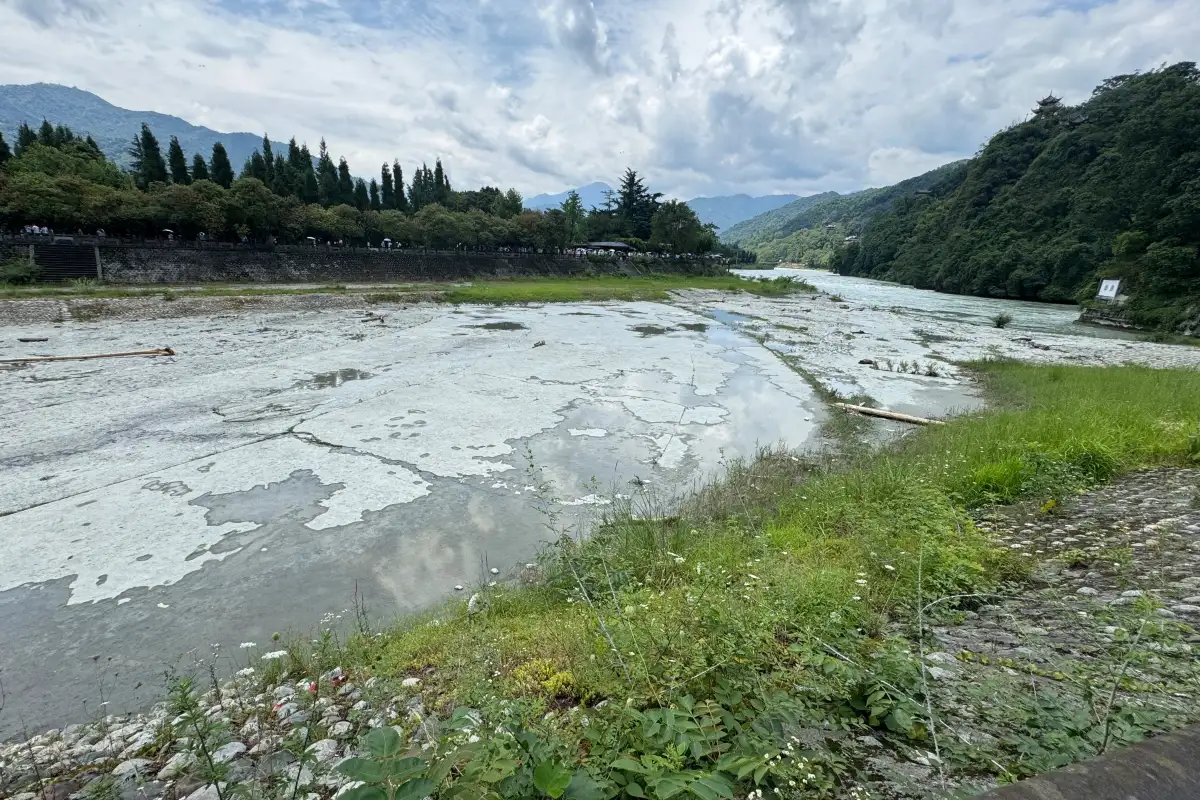
Summer (June–August). Flood season. The Min River runs high and brown-green, and the Feishayan Spillway works overtime, spinning white water back into the outer channel — the single most impressive “the ancient system is alive” moment of the year. The valley stays cooler than Chengdu; summer afternoons can rain, so pack a light layer. Local families come to cool off along the ancient town’s water edges in the evening.
Autumn (September–November). Clean air, thinner crowds after the national holiday week, and late-October color on the hillsides behind the temples. One traveler who visited in late November described snow still on the high peaks, green trees and early blossoms by the water — “บรรยากาศสวยงดงามคุ้มค่ามากๆ”, beautiful atmosphere and well worth it.
Winter (December–February). The quietest, mistiest version of Dujiangyan. The winter clock runs 08:00–17:30 with tickets until 17:00 and a 19:30 park exit. Water still flows — the system never stops — and the bare trees open sightlines that summer hides. Bring real warmth: the river valley is damp-cold even when Chengdu feels mild.
Time of day matters most
More than the season, the hour decides your visit. The full loop — Lidui Park, Baopingkou, the Anlan Bridge, Yuzui, Erwang Temple — is a 4–6 km walk, and the tour groups from Chengdu arrive in waves from about 10:00. Enter at 08:00 and you will have the bridge nearly to yourself, soft light on the fish-mouth dike, and enough quiet to hear the irrigation channel working. By mid-afternoon the paths peak; the last comfortable window is the two hours before the ticket deadline (17:30 summer / 17:00 winter) if you keep the loop tight.
- 08:00–10:00 — empty paths, low sun on the water, birdsong instead of loudspeakers.
- 10:00–15:00 — fullest hours; escape the flow by walking the loop backwards (temple first, bridge last).
- After 15:00 (summer) — the light turns golden and the crowds thin; in flood season the spillway is at its whitest.
Crowds: weekdays, weekends, holidays
Dujiangyan is one of China’s most-visited heritage sites — 57,958 Trip.com reviewers cannot be wrong about the demand. Weekdays in the shoulder seasons (March, June, late October–November) are the calmest. Chinese weekends double the flow, and the national holidays — Golden Week in October, Labor Day in May, and the Water Releasing Festival stretch in April — fill every path. Even then the park absorbs it better than most: the loop is long, and the reverse-walking trick (start at Erwang Temple, finish at the bridge) keeps you out of the current.
The Water Releasing Festival
Every year in early April, around the Qingming festival, Dujiangyan stages the Water Releasing Festival (放水节) — a tradition of more than a thousand years that re-enacts the spring removal of the temporary bamboo-and-stone closures and the ceremonial release of water into the channels. Ceremonies, folk performances and riverside markets run across the festival days. It is the most atmospheric week of the year to understand what the system means to the Chengdu Plain — and the busiest, so book tickets well ahead and enter at opening.
Is winter worth it?
Yes — with the right expectations. The water keeps flowing (the plain drinks in every season), the crowds vanish, and the mist that curls through the valley on winter mornings is the closest thing to a classical Chinese painting you will ever walk through. The trade-offs: shorter hours, a colder wind along the river, and the Anlan Bridge swaying with an extra chill. Dress warm, enter at 08:00, and finish in the ancient town’s teahouses with the steam rising off your cup — that is the winter visit done right.
Frequently asked questions
What is the single best day of the week to visit?
A weekday — Tuesday to Thursday — outside Chinese public holidays, in late spring or mid-autumn. You get the longest quiet window inside either seasonal clock, and the 3–5 hour loop never feels congested.
When does the park look most dramatic?
In summer flood season, when the Feishayan Spillway spins excess water back into the outer river. The system was designed for exactly this moment — watching it regulate a flood with no moving parts is the whole point of Dujiangyan.
Can I visit in the evening?
No — the park empties at 20:00 in summer season and 19:30 in winter season, and ticket sales stop earlier (17:30/17:00). The evening belongs to Guanxian Ancient Town and Nanqiao outside the gate, which glow with lanterns after dark.
How does the Water Releasing Festival affect tickets?
Expect holiday-level crowds in early April, possible ticket controls and adjusted schedules. Book online in advance, enter at 08:00, and confirm details on the hotlines +86-28-96526 / +86-28-87298269 before you go.
Lock in the early entry
The best time is opening time — whichever season you pick
From $11.99, instant confirmation, QR-code entry. Choose your date on Trip.com and be at Park Road for 08:00.
Then go deeper: the five headline highlights, the transport guide from Chengdu, and the half-day and full-day itineraries — or start from the Visitor Guide and build your own loop.
Sources & official references
- Trip.com — Dujiangyan Scenic Area listing (checked October 2026): two seasonal hour blocks, ticket deadlines and park-exit times.
- Water Releasing Festival: traditional April ceremony at Dujiangyan commemorating Li Bing and the annual channel opening.
- Verified traveler reviews on Trip.com (57,958 reviews, 4.7/5) for crowd patterns and season-by-season impressions.
- UNESCO inscription No. 1001 (2000) for the system’s continuous operation and the Mount Qingcheng pairing.
- Editorial visits across seasons, 2025–2026.
