













Most visitors arrive at Dujiangyan knowing one thing: this is where an ancient engineer taught a river to feed a plain. What surprises them is how walkable — and how legible — the whole machine is. In one 3–5 hour loop you can stand on every structure that makes the system work, watch it regulating a live river, and end in a temple that has thanked the man who built it for over two millennia. These are the five highlights that carry the whole visit, in the order the classic walking route serves them.
Key takeaways
- Three original works do all the magic: Yuzui divides the river, Feishayan flushes floodwater and silt, Baopingkou admits what the plain needs.
- The Anlan Suspension Bridge is the thrill and the classroom — mid-span is where the whole geometry finally clicks.
- Erwang Temple honors Li Bing and his son as “Two Kings” — climb it for the best rooftops-over-the-river views.
- Guanxian Ancient Town at the gate is the free encore: teahouses, snack streets, lantern-lit canals.
- Rated 4.7/5 by 57,958 travelers on Trip.com; recommended sightseeing time 3–5 hours; tickets from $11.99.
Quick answer: one standard admission ticket on Trip.com covers all five highlights — no separate bridge or temple tickets, no hidden gates.
Baopingkou — the Bottle-Neck Channel
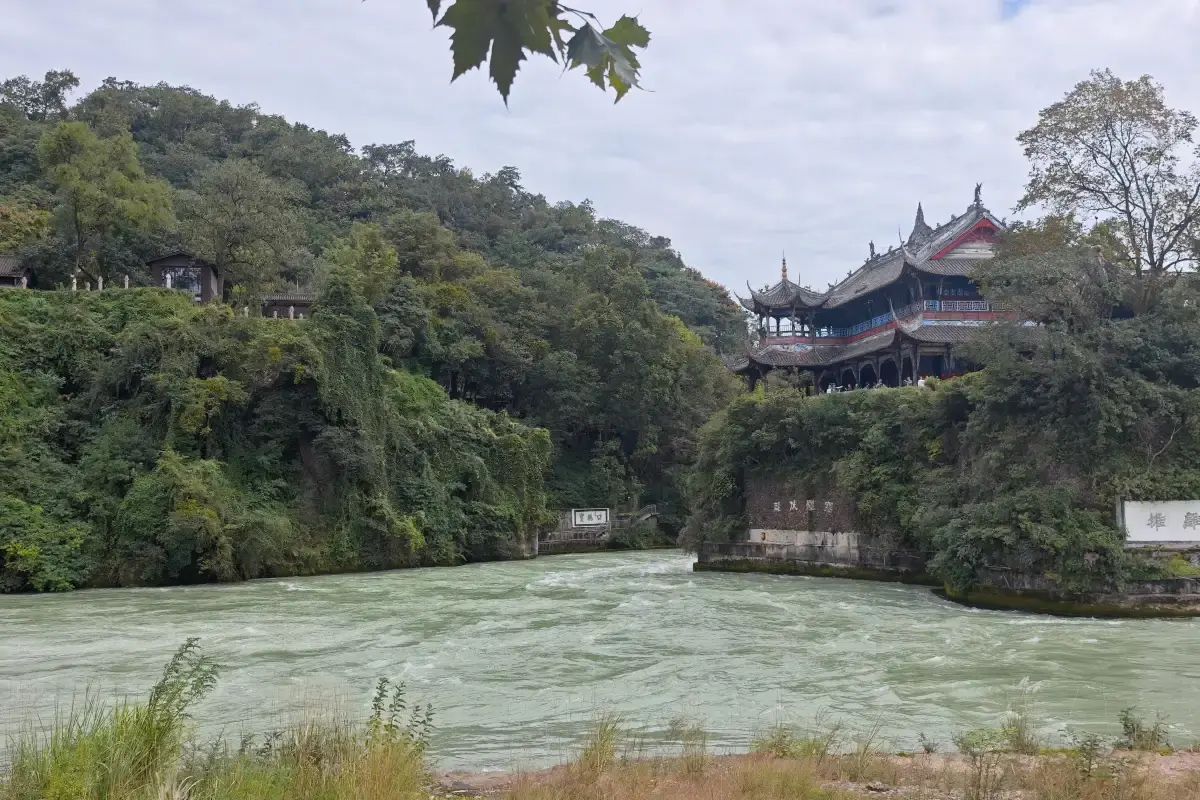
Start at Lidui Park, where the story begins. Around 256 BC, Li Bing’s crews needed the river to enter the plain through the shoulder of Mount Yulei — so they cut a channel through the rock. No gunpowder existed yet; the engineers heated the stone with fires and cracked it with cold water, year after year, until a vase-shaped water gate opened through the mountain. The isolated rock pillar left standing beside the cut — Lidui — is now a cliff-top park with the best close-up of water sliding into the irrigation channel. Stand at the railing and you are looking into the throat of the system.
The Anlan Suspension Bridge
From Lidui, the riverside path runs downstream to the Anlan Bridge — the wooden-plank suspension bridge that strides across the inner river on handrail cables. It sways, gently and deliberately, just above the current; children sprint it, photographers inch it, and everyone stops mid-span. That mid-span moment is the payoff of the whole visit: below you the flow divides around the fish-shaped dike, and for the first time you can read the entire system in one glance. The bridge has been rebuilt many times across its long history — modern steel-cored cables carry the load — but the crossing experience remains pure Dujiangyan.
Yuzui — the Fish Mouth
Cross the bridge and walk out to Yuzui, the dividing embankment shaped like a fish lying nose-upstream. This is the masterstroke: no gates, no machinery, just geometry. The dike splits the Min River into the inner channel — sized to admit exactly the water the plain needs — and the outer channel that carries the rest to the Yangtze. In flood years the split shifts automatically with the current; in dry years the inner channel keeps its flow. A 2,280-year-old water computer, still computing, right under your feet.
Feishayan — the Flying Sand Weir
Back along the inner bank stands Feishayan, the spillway that made the design immortal. Set lower than the channel bed, it lets excess water — and, crucially, the river’s silt load — spill back into the outer channel during high flow. The silt flushing is the quiet genius: it keeps the irrigation channel from silting up, which is why this system survived when so many ancient works did not. Visit in summer flood season and the weir churns white; visit in autumn and it murmurs. Either way, you are watching maintenance-free hydraulics that have run since the Warring States period.
Erwang Temple
Climb the slope of Mount Yulei to Erwang Temple — the “Two Kings” Temple where Sichuan has thanked Li Bing and his son for twenty-two centuries. Ming-era courtyards stack up the hillside: incense coils, drum and opera towers, ancient cypresses, walls of steles and a small museum of the system’s history, including the bamboo cages of river stone and wooden tripods that held the river before modern concrete. From the upper terraces, the whole weir works spread out below like a diagram — the best overview photograph of the day is taken here.
And the encore: Guanxian Ancient Town
Exit through the old county town at the gate. Guanxian grew rich guarding the water works, and its streets still run to the rhythm of the river: canal-side promenades, teahouses with bamboo chairs on the pavement, snack streets selling Sichuan’s greatest hits, and Nanqiao — the corbelled bridge-and-corridor at the park entrance that glows with lanterns at dusk. It costs nothing to wander, and it converts a 3-hour engineering walk into a full, unhurried day.
Frequently asked questions
Can I see all five highlights in one visit?
Yes — they sit on one 3–5 hour loop, which is exactly why the recommended sightseeing time is 3–5 hours. Enter at 08:00 and you will do them all comfortably, with a teahouse stop to spare.
Is the Anlan Bridge safe for kids and nervous walkers?
The bridge is well maintained, with handrail cables both sides and a walkway that sways gently rather than lurches. Most children love it; nervous walkers cross holding the rails at the calmest hour — right at opening. It is included in the standard ticket.
Which highlight should I see first?
The classic route runs Lidui Park (Baopingkou) → Anlan Bridge → Yuzui → Feishayan → Erwang Temple — the order in which the engineering story unfolds. The insider’s reverse route starts at the temple and finishes at the bridge, meeting the tour groups head-on instead of following them.
Do I need a guide to understand the works?
No — the signage along the loop is bilingual and genuinely good, and our Visitor Guide walks you through the mechanics step by step. That said, licensed local guides at the gate bring the Li Bing legends alive; agree a price before starting.
Walk the works yourself
Five highlights, one ticket, one unforgettable loop
From $11.99 with instant confirmation — pick your day on Trip.com and start at Lidui Park.
Keep planning: when to go in the best-time guide, how to get there in the transport guide, and full day-plans in the itineraries guide.
Sources & official references
- Trip.com — Dujiangyan Scenic Area listing (checked October 2026): recommended sightseeing time 3–5 hours, tickets from $11.99.
- UNESCO World Heritage inscription No. 1001 (2000): the Yuzui Bypass Dike, Feishayan Floodgate and Baopingkou Diversion Passage as the system’s three key components.
- Verified traveler reviews on Trip.com (57,958 reviews, 4.7/5) for on-the-ground impressions of the bridge, temple and loop.
- On-site interpretive signage and Erwang Temple exhibits, verified by our editorial team on 2025–2026 visits.
